Quick answer
As a practical guide, a kitchen chimney with a rated airflow of about 1,000 m³/h or more comfortably handles daily frying, tarka and karahi cooking in most Pakistani kitchens. To check your own kitchen, multiply its volume in cubic metres by 10 for the minimum, or by 15 if you fry heavily. Then add headroom for the duct, and pay as much attention to static pressure and noise as to the headline airflow number.
Ask ten shop assistants how much kitchen chimney suction power you need and you will hear ten different answers, usually ending in "more is better". That is not much help when you are choosing an appliance that will run every single evening for years.
The truth is simpler and more useful. Suction power is a combination of three numbers: airflow, static pressure and noise. Once you understand how they work together, you can size a hood for your own kitchen in about two minutes, and you will be able to read any specification sheet with confidence. This guide uses real Fotile ratings so you can see the numbers in practice.
01What "m³/h" actually measures
Airflow is the volume of air the hood can move in one hour, written as cubic metres per hour or m³/h. A hood rated at 1,450 m³/h can, in ideal conditions, move 1,450 cubic metres of air through its fan every hour. Higher numbers mean the hood can pull smoke, steam and oil droplets away from the pan faster.
The catch is the phrase "in ideal conditions". Airflow figures are normally measured under standard test conditions (often shown as IEC airflow) with no duct attached. In your kitchen there is a duct, usually with a bend or two, a grille and an outside cap. Each of these takes a bite out of the rated figure, which is why the next number matters so much.
02Static pressure: the number most buyers skip
Static pressure, measured in pascals (Pa), is how hard the fan can push against resistance. Think of it as the difference between a fan that works well on a bench and a fan that still works when it has to push smoke through a long duct, around a corner and out into the wind.
A hood with strong static pressure holds on to more of its airflow once it is installed. This is especially important if your kitchen is on an upper floor, the duct run is long, or the outlet faces the prevailing wind. When you compare two hoods with similar airflow, the one with the higher static pressure will usually perform better in a real home.
03A simple way to size a hood for your kitchen
Here is the method many installers use. Measure the length, width and ceiling height of the kitchen, multiply them to get the volume in cubic metres, and then multiply by 10 for a standard kitchen or by 15 for a kitchen with heavy frying.
Worked example: a kitchen of 3.5 m by 3 m with a 2.8 m ceiling has a volume of 29.4 m³. Multiplied by 10, the minimum is about 294 m³/h. Multiplied by 15 for heavy frying, it is about 441 m³/h.
| Kitchen floor area | Volume (2.8 m ceiling) | Minimum airflow (x10) | Heavy frying (x15) |
|---|---|---|---|
| 6 m² (compact flat kitchen) | 16.8 m³ | 168 m³/h | 252 m³/h |
| 10 m² (average family kitchen) | 28 m³ | 280 m³/h | 420 m³/h |
| 15 m² (large kitchen) | 42 m³ | 420 m³/h | 630 m³/h |
| 20 m² (open plan or island kitchen) | 56 m³ | 560 m³/h | 840 m³/h |
Notice that these numbers are well below the 1,400 m³/h and above that you see on premium hoods. That is not a trick. The volume rule gives you the floor for changing the air in the room. It does not tell you how well the hood captures a hot, oily plume rising off a 5 kW burner before it spreads through the house. Capture is what keeps your curtains, sofas and walls clean, and it needs extra power in reserve.
04Why desi cooking asks for more
Pakistani cooking is hard on a hood. Bhunai on high heat, tarka sizzling in hot oil, deep frying pakoras and samosas, and a karahi at full flame all create thick, greasy smoke in large quantities. A wok-style burner at 5 kW puts out far more heat and fume than the gentle simmering that many hood ratings are designed around. If your daily routine includes any of these, you should size toward the upper end.
It also helps to match the hood to the hob. A wide hood over a three-burner hob with 5 kW burners needs more capture width than a compact hood over a two-burner stove. You can see typical burner outputs on our gas hobs page, and our guide to getting the right heat for chicken karahi shows why high flame matters for flavour as well as for your hood.
05Real Fotile ratings compared
Here are three Fotile hoods and what their specification sheets say. Use them as a reference point when you read any other brand's numbers.
| Model | IEC airflow | Static pressure | Worth knowing |
|---|---|---|---|
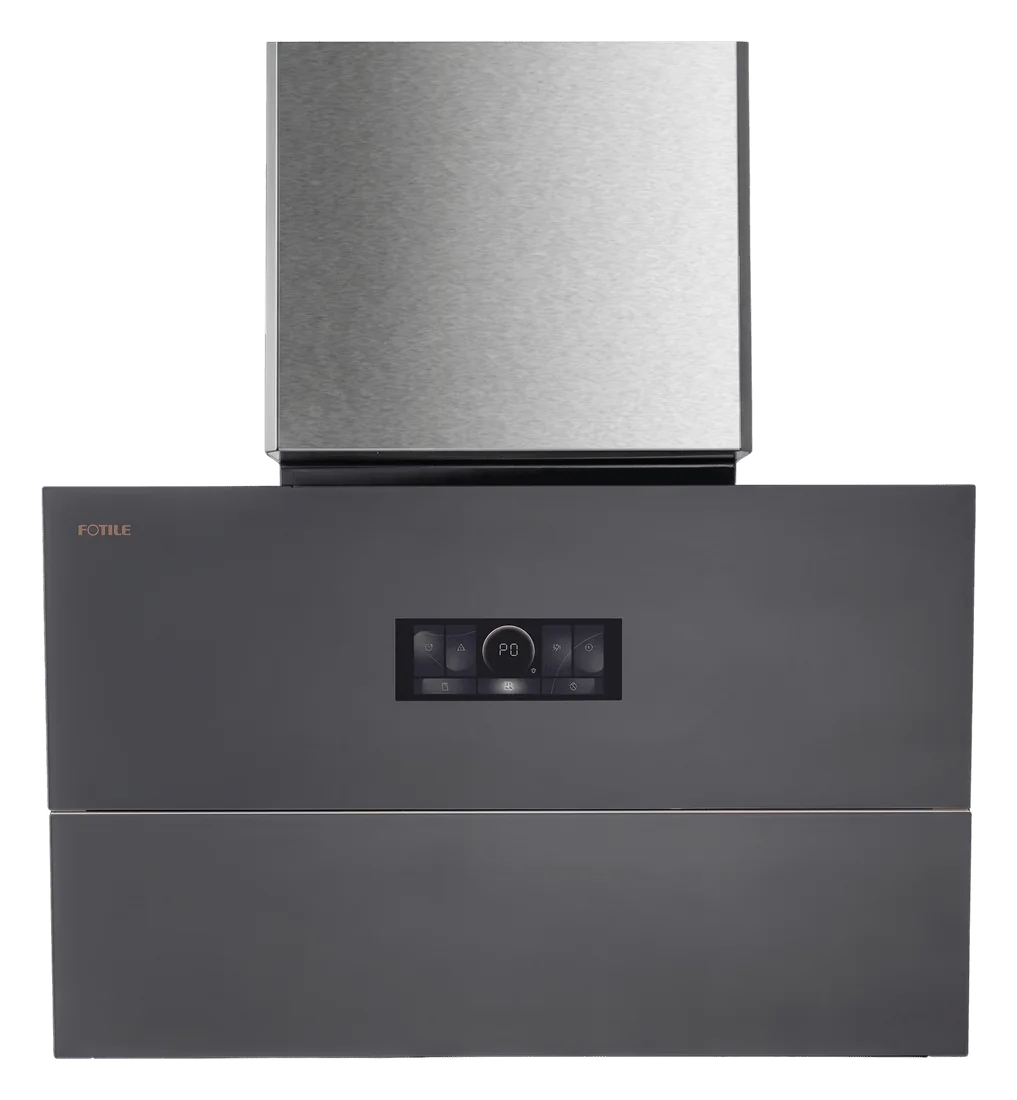
| EMG9036 | 1420 m³/h | 880 Pa | 90 cm stainless steel with black panel, 258 W motor, 3 fan speeds, corrugated filter |
| JQG9051 | 1450 m³/h | 1100 Pa | Adjusts automatically to hob temperature and duct resistance, infrared sensing |
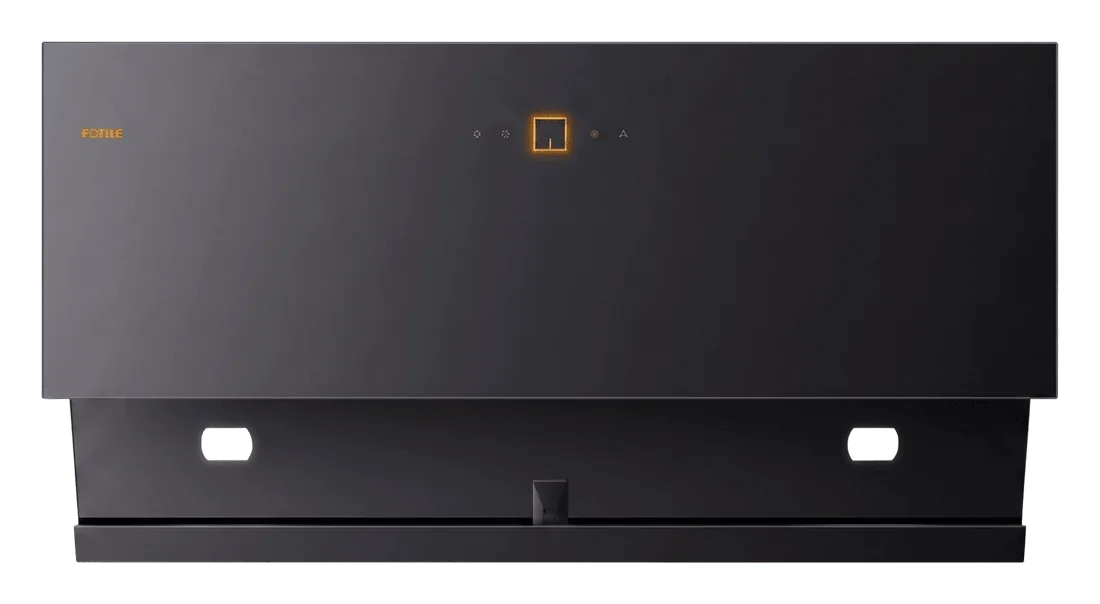
| AMG9054-Y | 1650 m³/h | 1230 Pa | BLDC motor, 49 dB(A), hood-hob linkage with Wave and Touch control |
Look at how the pressure rises along with the airflow. The JQG9051 and AMG9054-Y can keep their performance through a longer or more awkward duct than a hood with the same airflow but lower pressure. The flagship AMG9054-Y also manages this at 49 dB(A), which brings us to noise.
06Noise: the reason people stop using their hood
A hood that is too loud at the speed you need will simply not get switched on. This is the quiet reason many kitchens with expensive hoods still fill with smoke. The best approach is a hood with plenty of capacity that does its work at a lower, quieter speed. Running a powerful hood at 50 percent is both quieter and more effective than pushing a small one to its limit.
Our guide to understanding sones ratings explains how to compare noise figures between brands, since decibels and sones are not measured the same way.
07Can a hood be too powerful?
In a small, tightly sealed kitchen, yes, up to a point. A strong extractor removes air from the room, and that air has to come from somewhere. If there is no open window, door or vent, the hood has to fight for replacement air and performance drops. In homes with a gas geyser or other flued appliance in or near the kitchen, strong extraction can also pull exhaust gases back into the room. If that applies to you, leave a window open while cooking and ask your installer to check the room before commissioning the hood.
08Five mistakes to avoid when choosing suction power
- Buying on airflow alone. Check static pressure and noise next to it.
- Ignoring the duct. Every metre and every bend reduces delivered airflow. Keep it short and straight.
- Choosing a hood narrower than the hob. The canopy should cover the burners, otherwise smoke escapes at the sides.
- Forgetting replacement air. A sealed kitchen limits any hood, whatever its rating.
- Skipping filter care. A clogged filter cuts airflow no matter how strong the motor is. Our appliance care guide covers cleaning routines.
09Ducted or ductless: a quick note
Everything above assumes the hood sends air outdoors. Ductless recirculation hoods filter the air and return it to the room, which behaves very differently with heavy oil and steam. We compare both in ducted vs ductless range hoods, and our complete guide to choosing a range hood covers style, width and controls once you have settled on power.
10Your 2-minute checklist
- Measure the kitchen and work out the volume. Multiply by 10, or by 15 if you fry a lot.
- Choose a hood rated comfortably above that number, since duct losses will reduce it.
- Compare static pressure. Higher is better for long or bent ducts.
- Check the noise rating at the speed you will actually use.
- Make sure the canopy is at least as wide as your hob.
- Plan a short, straight duct and a way for fresh air to enter the kitchen.
If you would like to see the full lineup before you decide, browse every model on our kitchen hoods and chimneys page. For a broader look at how Fotile hoods are designed, read our guide to Fotile kitchen hoods, and see what drives kitchen hood price in Pakistan when you are ready to compare budgets.
Frequently Asked Questions
How much suction power is good for a kitchen chimney?
As a practical guide, around 1,000 m³/h or more of rated airflow suits heavy Pakistani cooking in most homes. For an exact check, multiply your kitchen volume in cubic metres by 10, or by 15 for heavy frying, and choose a hood rated well above the result to allow for duct losses.
What does m³/h mean on a range hood?
It means cubic metres of air moved per hour. A hood rated at 1,450 m³/h can move that much air through its fan every hour under standard test conditions. Real performance in your kitchen is lower once a duct, bends and an outside cap are fitted.
What is static pressure and why does it matter?
Static pressure, measured in pascals (Pa), shows how well a hood can push air against resistance such as a long duct. A hood with higher static pressure keeps more of its airflow in a real installation, so it usually performs better in homes with longer or more complicated duct runs.
Is higher suction always better for a kitchen chimney?
Not always. Very high suction in a small, sealed kitchen can starve the hood of replacement air, and near a flued appliance such as a gas geyser it can cause back-draught. A powerful hood is excellent when you leave a window open and run it at a comfortable, quiet speed.
Which Fotile hoods have the highest airflow?
Among the models compared here, the AMG9054-Y leads with a maximum IEC airflow of 1650 m³/h and 1230 Pa static pressure, followed by the JQG9051 at 1450 m³/h and the EMG9036 at 1420 m³/h. Our team can match any of them to your hob and duct layout.
Not sure which chimney suits your kitchen?
Send us your kitchen size, the hob you use and the length of the duct run on WhatsApp, or call 042 111 13 15 17. Our team will suggest the right model and confirm today's price and availability the same day. You can also add the hoods you like to your Quote Basket from the Range Hoods page and we will take it from there.